Why don’t you give better feedback?
One of my clients is working to provide stronger feedback to their direct reports. They acknowledge they are not doing a great job in providing both positive and critical feedback, and this competency is now showing up in culture surveys in the organization. In our coaching conversations, my client has communicated their goal is to ensure all their direct reports understand not only how they will be evaluated but also that they have a good understanding of their current performance. Part of our discovery conversations has uncovered a lack of strong models of leadership around feedback for my client. They have not been a manager for a significant amount of time (less than 7 years), but they have had significant responsibility in that time.
My expertise in providing feedback has been refined over 27 years of leading and managing people, AND I still do a poor job in providing feedback to my direct reports. For me, it is the most common piece of feedback I receive. I am good at lots of things, but feedback has always been a growth area for me. Now, some folks that know me would say that I am pretty good at it, but I know the truth.
For this newsletter, we aren’t going to talk about what is good feedback. There are enough programs, resources, and technical knowledge out there. We are going to talk about why we don’t do it well!

First, why is it so hard to do?
How can we get better at giving feedback?
How do we know we are getting better?
Why is it so hard to do?
I think feedback is hard to do consistently well because it requires high levels of procedural knowledge. Let me take a step back and talk about how we learn things in the world. (This is the short version of an enormous body of research on this topic, so don’t come after me, do your own research!!)
Basically there are two types of knowledge we develop as we are learning something new: declarative knowledge and procedural knowledge. In most cases, new learning starts with declarative knowledge—learning how to drive a car (hands on 10 and 2) or learning how to give feedback to a direct report (follow these steps in the protocol). There are rules we follow, and we try to stay within those rules. Through repetition and practice, this new learning transforms into procedural knowledge, allowing us to execute the tasks (like making our favorite cookies or speaking a foreign language), automatically and naturally, without having to consciously think about the rules (or the recipe).
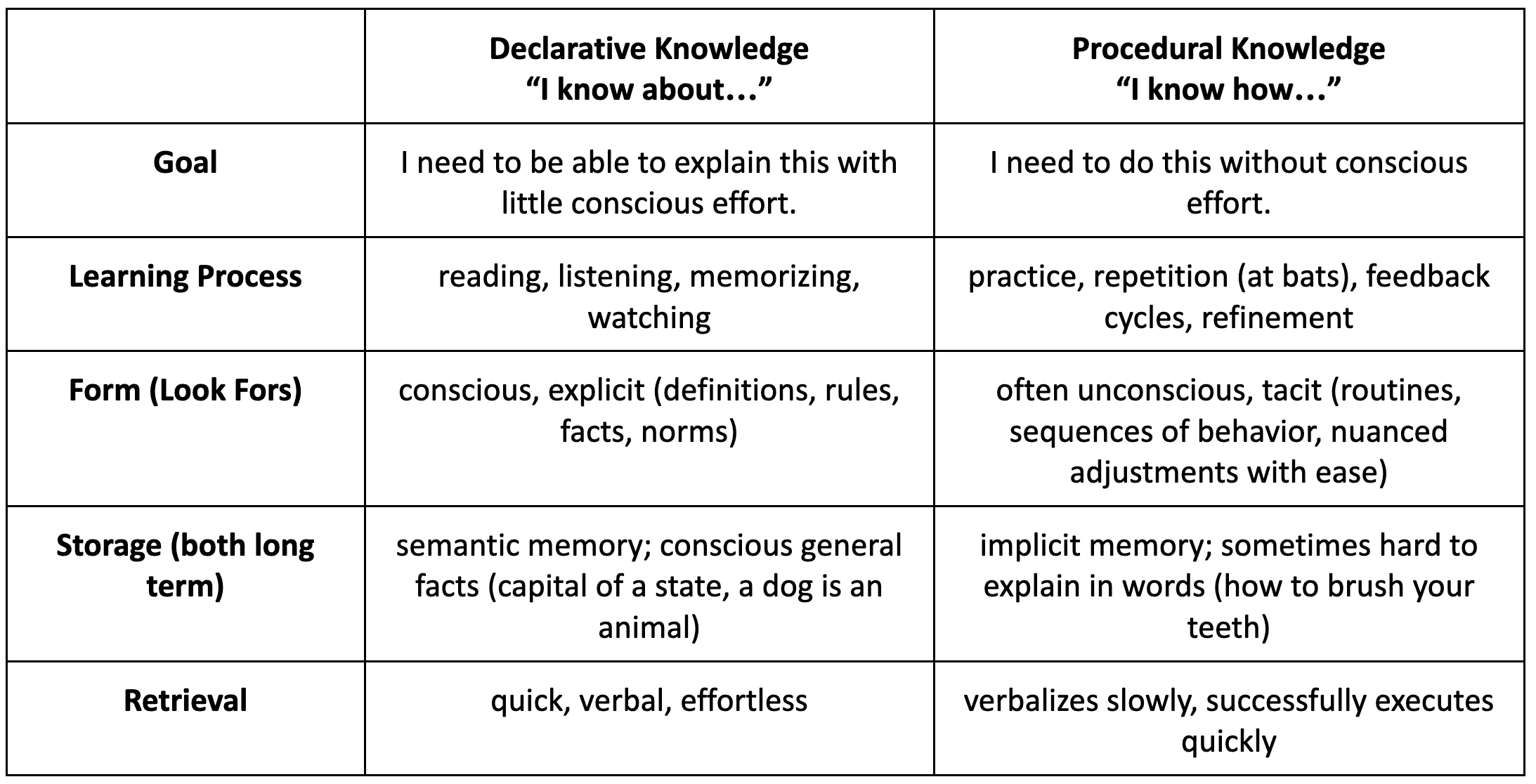
This is a simple chart explaining the difference.
If we apply this information to how we give high quality, transformative feedback, I am confident you, like me, have participated in hours of training and built a strong volume of declarative knowledge. The problem is how we translate the information we learned into our daily practice, effortlessly. In research, some call this the “knowledge-doing gap.”
It is the failure to put into practice what you have learned, particularly in a training context. There are three major reasons for this challenge:
Contextual Overload: Declarative knowledge is usually taught in a clean, conceptual environment. Real-world procedural skills are messy. Often the real-world context requires split-second judgment and adaptation, which facts alone cannot provide.
Tacit Knowledge: Much of a procedural skill is unarticulated or tacit knowledge. A manager really good at strategic thinking cannot always fully explain the “moves” they make when they are engaged in strategic planning. This “feel” is only acquired through doing, failing, and adjusting.
Inefficient Consciousness: When you first try to perform a new skill (like driving a stick shift), you rely heavily on your conscious, slow-moving declarative knowledge (“Clutch in, shift to 1, slowly let the clutch out…”). Once the skill is proceduralized, it becomes automatic. The conscious mind is freed up to focus on strategy (e.g., navigating traffic) rather than mechanics (shifting gears).
What should we do instead to get better at giving feedback?
Practice. Intentional, focused, mindful practice. One way to close the “knowledge-doing gap” is to convert the declarative knowledge into automatic responses through large volumes of experiential learning and practice in a variety of settings. Let’s be clear here: practice alone isn’t enough. We have to be focused and intentional in our practice. Otherwise, we might cause harm. Focused, intentional practice involves setting specific, challenging goals; constant measurement of our goals (see our section on “How do we know we are getting better?”); and immediate, detailed feedback (both internal and external feedback). Opportunities to practice over and over again with feedback and correction cannot be understated.
Given that declarative knowledge tells you what to do, the first few attempts at providing feedback will provide you real world data about how you need to adjust your approach. Make sure your attempts are happening in the real world. Role plays are a helpful scaffold, but you must complete the skill (give feedback) in a realistic scenario. This provides opportunities for you to both experience and reflect while practicing and tinkering with your methodology.
How do we know we are getting better?
To measure whether you are improving in your practice, look for/listen to:
feedback from the individuals receiving the feedback from you (to your direct report: “Could you please provide me some feedback on this feedback I provided?”),
someone observing your practice (from your coach: “Good job delivering specific data along with impact statements about why this feedback matters.”),
interrogating your own self awareness (in your journal: “I noticed that I was uncomfortable when I was giving feedback to this person. I wonder why?”), and/or
a positive change in the behavior/relationship with your direct report (from your direct report: “I appreciate your feedback. I used it and it made a world of difference.”)
A final note about motivation.
If you don’t believe you can perform the skill (low self-efficacy), you won’t put in the necessary hours of practice. Some of us might feel this way right now about providing feedback. For me, there are a few situations where I remain uncomfortable providing feedback. I overcome those moments by connecting the need to provide feedback to my values and genuine concern for the individual I am working with. I believe in the capacity for all of us to make positive change, and giving (and receiving) feedback is a key lever for that to happen.
As always, this section is about unlocking/disrupting your thinking. As you read, think about the ways in which your current models of leadership are serving (or not serving) you well!
"Flying on Your Mother's Memory"
The young crane had memorized the crossing before she ever felt the wind change.
Her aunt had drawn it for her a hundred times in the mud along the marsh's edge — the shape of the coast falling away, the long stretch of gray water with no islands, no resting stones, nothing but sky pressing down on sky for the better part of a day. You go until you cannot see land behind you before you can see it ahead. That is the middle. You do not turn around in the middle. The young crane had listened. She had traced the marks with her own bill until she could have drawn the crossing blind. She knew the wind patterns, the cloud signs that meant weather was building far to the south, the particular slant of light that said dusk was still an hour off, not falling fast.
She knew all of it. She had never done any of it.
So when the flock lifted off the marsh in the gray hour before sunrise, she rose with them. Then, at the very edge of the shoreline, where the mud gave way to open water and the last reeds thinned into nothing, something in her chest seized. Not fear exactly. Something quieter and more stubborn than fear. Her wings kept beating. Her body kept moving forward with the others. But some part of her had simply stopped, the way a held breath stops, and she did not know what that part was or why it had chosen this exact moment, this exact stretch of gray, to refuse.
She almost didn't mention it. It seemed a foolish thing to bring to her aunt who flew near the front with the ease of an expert who had made this crossing eleven times and no longer had to think about any of it — not the wind, not the light, not the terrible blankness of water with no place to land. Her aunt's flying looked less like effort and more like agreement, as though she and the sky had long ago settled something between them.
But an hour into the crossing, when the shoreline was a rumor behind them and the water ahead had not yet resolved into anything, the young crane found herself beside her aunt anyway, matching her wingbeat, and the words came out before she'd decided to say them.
"There's a place in my chest that doesn't want to be here. It hasn't gone away."
She expected her aunt to tell her this would pass, that it was only nerves, that she should breathe through it the way you breathe through the beginning of any hard thing. Instead her aunt was quiet for the space of several wingbeats, studying her with one dark eye.
"Where," her aunt said finally, "exactly? Show me where."
The young crane didn't understand the question at first. But her aunt waited, unhurried, the way she waited for weather to reveal itself before committing to a heading, and so the young crane turned her attention inward and found it — not the whole crossing that frightened her, but one particular moment inside it. The instant the shoreline disappeared. The instant there was nothing behind her to return to and nothing ahead she could yet see.
"There," she said. "That's where it happens. Right when I lose the land."
Her aunt nodded slowly, as though this were not a confession but a piece of navigation, something worth marking the way you'd mark a change in wind.
"That is not the crossing telling you to turn back," her aunt said. "That is the crossing telling you where you are still flying on your mother's memory instead of your own. Everything before that point, you have done in practice — the takeoff, the rising, the first hour. Your body already knows those. But losing sight of land, you have only ever heard about that. You have never felt it and kept going. So of course something in you seizes. It has no experience to stand on yet. It is not wrong to seize. It is only early."
"So what do I do?"
"You do exactly what you are doing. You keep beating your wings, and you let that place in your chest be afraid without letting it steer. Somewhere past the middle of this crossing, on some crossing — maybe not this one — it will stop seizing there. And then you'll notice the fear has simply moved. It will show up somewhere else you haven't yet flown blind. That is not a flaw in you."
They flew on. The land was gone now entirely, water everywhere, the sky a single unbroken gray. The young crane felt the seizing place in her chest again, and this time she did not mistake it for a warning to turn around.
She only noted it, the way you'd note a landmark.
Here, she thought. This is still mine to learn.
And she flew on into what she did not yet know, carrying the knowing of it like a compass she was only beginning to trust.
Apply the Learning - A Case Study: The Flinch
Marisol Reyes had done everything right.
In four years as Director of Regional Sales for a mid-sized medical device company, she'd completed every leadership program on offer. She could recite the feedback models by heart: SBI, radical candor's care-personally, challenge-directly matrix, Pendleton’s Model, BOOST model, and others. Her direct reports described her as "approachable" and "clear about expectations." On paper, feedback was not her problem.
But one conversation had been rescheduled four times in six weeks.
Diego Ortiz was her most senior account executive, eleven years with the company, the person who had trained half the sales floor, including, in his first year, Marisol herself. Diego's numbers had been sliding for two quarters. Worse, in the last regional meeting, he'd grown visibly irritated when a newer rep's idea was well received, and made a comment afterward, "must be nice to get credit for reinventing the wheel," that two reps had mentioned to Marisol privately.
She knew exactly what the conversation required. She'd drafted talking points three times using the SBI model without difficulty. She could write the script. She simply couldn't find the time to have the conversation.
She mentioned this, almost as an aside, to her executive coach, Priya Nandan.
"I've just been slammed," Marisol said. "Diego's on the list, I just haven't found the window."
"You've given hard feedback before," Priya said. "You did it with the Denver team last spring without blinking. What's different about this one?"
Marisol started with logistics again, then stopped. "He trained me. Eleven years ago. He was patient with me when he didn't have to be. And now I'm supposed to tell him he's coasting."
"What happens in your body when you picture that conversation? Not the content, but the moment right before you'd start it."
"My stomach drops. Like I'm about to disappoint someone I owe something to."
"What do you usually do with a feeling like that?"
"Push through it. Or avoid it until I'm better prepared" Marisol mumbled.
"What if this feeling is telling you something true? That this isn't Denver, and treating it like it is has been a mistake?" Priya continued, “Spend time in the feeling and write down in your journal what is coming up for you.”
“Okay.”
“Now we need to choose a day when you are going to have the conversation with Diego. We will end our coaching conversation today with a date and a commitment that you will do it on or before the date we decided. I will ask you about it in our next coaching conversation,” Priya stated firmly. “Are you good with this?”
Marisol responded, “Yes. This is exactly what I need.”
Over the next week, Marisol noticed the drop again each time she opened her notes for Diego. She asked herself what, specifically, it was attached to. Not "giving feedback" in general, she'd done that for years on smaller things. It was narrower: naming, out loud, that the balance between them had shifted. No training had ever modeled that conversation.
She had procedural comfort with feedback-as-correction. Almost none with feedback-as-repositioning, acknowledging a changed relationship, not just a performance gap.
When the date to talk with Diego arrived, Marisol changed her opening to the conversation. She asked to speak with Diego and offer some feedback.
When Diego entered her office, instead of the SBI script she always used, she led with the relationship itself: "This conversation feels different for me, because of our history. That shouldn't stop me from having it, but I wanted you to know I see it too."
Diego, braced for something clinical, visibly softened. The conversation that followed was still direct, but it didn't require pretending the history wasn't in the room. She still felt the drop. She let it be there, without letting it choose her words.
At her next coaching session, as promised, Priya asked how the conversation with Diego had gone.
"Better than fine. But I had that same drop yesterday, with a different report. Over something small."
"So the feeling followed you to new terrain."
"Which either means I'm bad at this, or…"
"Or it means you're finding the next edge," Priya said. "The drop isn't a verdict on your competence. It's a map of where you're still building the road as you walk it."
Case Study Questions
Marisol had strong declarative knowledge of feedback models and had delivered hard feedback successfully before. Why didn't that competence transfer automatically to the conversation with Diego?
Priya redirects Marisol from "what do I say" to "what happens in your body." What's the risk of treating discomfort as noise to override? What's the risk of treating it as an automatic stop sign?
Marisol's shift wasn't a better script — it was naming the relationship change out loud. What does this suggest about the limits of procedural frameworks when the barrier is discomfort with a kind of conversation, not lack of knowledge?
Priya suggests the drop will keep "pointing to what's next" rather than disappearing. How might a leader tell the difference between discomfort signaling a real skill gap versus discomfort that's simply the edge of any unfamiliar but necessary conversation?