One of the first pieces of advice I always give to senior executives is to schedule their vacation. Do it early and make sure you do it at least twice a year. By my definition, a vacation is time off from work for five or more consecutive business days. Long weekends (take off Friday and/or Monday) don’t count. There is something about unplugging from work for five days or longer. The consequences affect both the leader and the organization when a leader decides to take this type of time off from work.
For most of the folks I coach outside the education sector, this seems ludicrous. Until probably 10 years ago, most of my clients in the education sector felt comfortable taking a week off - usually in the summer or during one of the scheduled breaks during the year (e.g., spring break, winter break, summer break). Now, these leaders join my non-educator client base, finding the prospect of taking more than three days off just inconceivable.
Now, I would be lying if I did not both sympathize (understand their trepidation) and at times empathize (physically and emotionally feel their trepidation) with their feelings about taking "that much time" off. All of my clients (and myself…let’s be honest here) know they should take the time off. They likely scheduled the time off and rescheduled it at least once. All of them (including myself) can admit that we compromised: a long weekend here, a "working vacation" there, and a five-day trip to the beach with your laptop on the coffee table and your Slack messages pinging on your phone while the waves crash in the background.
In my experience, executives behaving this way often rationalize their actions with statements like:
"Now is not a good time for me to ‘disappear’ for a week. I need to stay visible for my organization."
"We have some critical deadlines that need to be met, and I need to be available to make decisions."
"If I were unreachable for five business days, no one could make the call on ____ (fill in the blank)."
What you are really saying is, "the organization cannot function without me for a full work week." This is illuminating for both the leader and the organization. Let’s talk about why.
So, why can’t we take a five-day vacation? What should we do instead? Why should we do it?
The root cause: Why can't we take a five-day vacation?
The usual explanations I hear are workload, deadlines, and a crowded calendar. If we are honest with ourselves, those excuses (not explanations) are symptoms of a belief that your presence must be load-bearing.
When we say load-bearing, we mean that you perceive your presence as significant in supporting the organization. If you are removed (like a load-bearing wall), the organization collapses. For some executives, this might be an accurate perception. For others, this might be a misperception. For our purposes in this newsletter, let’s assume this perception is accurate.
Executives rarely build this load-bearing presence deliberately. It accumulates over time through a variety of actions, including: 1) decisions flow upward because it is faster than building a team's judgment; and/or 2) escalations default to you because you are the person who knows the answer. Unfortunately, over time your absence stops being an inconvenience and becomes a perceived risk, and the risk is real. Below are a few indicators of this type of dynamic:
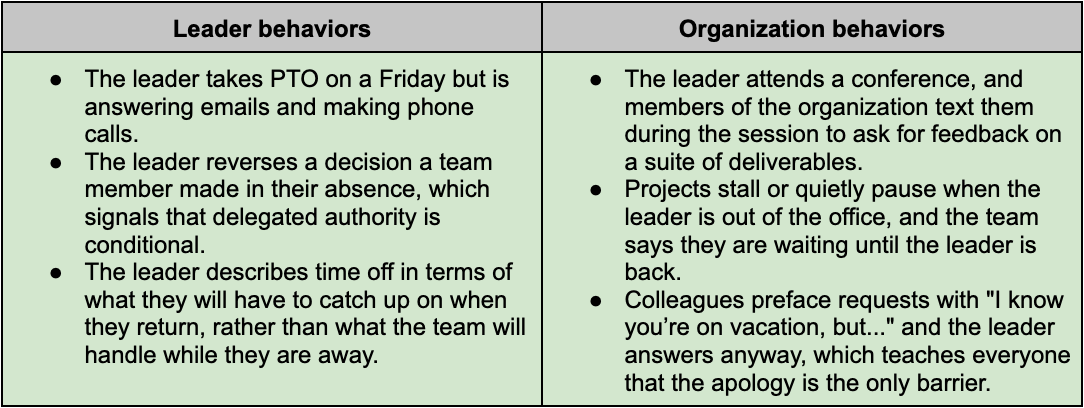
There are three reinforcing conditions that keep this dynamic in place:
Identity and signaling. For many executives, availability is a proxy for commitment. Visible overwork reads as dedication, and a week of silence can feel like the opposite.
Misunderstanding recovery. Most of us treat rest as a dose we can split into smaller pieces. The research suggests otherwise. Research on psychological detachment published online in 2014 by Sonnentag and Fritz shows that recovery depends on mentally disconnecting from work, and that disconnection takes time to achieve. In my experience, many people need several days just to stop scanning for problems, and a three-day weekend often ends right as the wind-down finishes.
A false sense of control. Checking in feels like a low-cost insurance policy. However, partial presence preserves the stress of work without delivering a high-quality output. Most importantly, it leaves your team uncertain about whether they are truly empowered to decide.
Knowing the root cause, here is what to do instead.
If your problem is dependency, the fix is not simply "take a vacation." Instead, you will need to use the vacation as a deliberate stress test for your organization. That means you prepare for it as you would any other strategic initiative, explicitly describing the conditions under which folks should reach out to you. Take at least five consecutive business days away, and treat the planning as part of the work. Below are some explicit steps:
Set your vacation date early and make it public. Announce it months ahead, and put it on calendars before anything else claims the slot. A visible commitment is harder to erode.
Name a decision-maker, not just a point of contact. Delegate real authority for defined categories of decisions and spell out the thresholds that would justify reaching you. Everything below the line is theirs. This is the single most important step because a stand-in with no authority is just a relay.
Define "emergency" in advance. Write it down in plain terms: what truly requires your attention, who can make that call, and how you will be reached. Narrow the channel to one (a phone call, not the full inbox). A clear definition reduces both unnecessary interruptions and your own urge to check.
Commit to a real break. Remove work email and messaging apps from your phone for the week. If a complete disconnect is not feasible, set a strict limit: one brief, scheduled check, not a rolling one. Partial vigilance forfeits much of the benefit.
Debrief when you return. Ask what slowed down, what escalated unnecessarily, and what your team handled better than expected. This is your most honest diagnostic of where the organization depends on you, and it gives you a to-do list for building resilience.
Why you should take a five-day vacation
It would seem obvious that we should do this, but just in case you are not convinced, here are a few reasons why:
Restoration for you. Sustained stress and insufficient recovery are associated with poorer attention, weaker judgment, and diminished creativity, which are the very capabilities of senior leadership. The effects of vacation include measurable gains in well-being and lower strain after time off.
Leadership bench building. Predictable time off provides opportunities for teams to plan collectively for uninterrupted time away, which improves communication, teamwork, and job satisfaction. When a leader prepares their team for their absence, it forces clarity about roles, decision rights, and priorities. Your team gets practice at exercising judgment, and you get evidence of who is ready for more.
Reductions in organizational risk. An organization that cannot operate for five consecutive business days without its executive has a continuity problem. A planned absence surfaces weakness while the stakes are low rather than during an illness, family crisis, or sudden departure.
Wellness signaling. When a leader takes real time off, comes back sharper, and the business has run well, the message to the organization is that sustainable performance is valued and that people are trusted. That is far more persuasive than any wellness memo.
A long weekend is a pause, but five days of real disconnection is both a recovery strategy and a leadership audit. The question is not whether you can afford to be away, but what it says about your organization if you can't.
As always, this section is about unlocking/disrupting your thinking. As you read, think about the ways in which your current models of leadership are serving (or not serving) you well!
One Bar
The cabin had no signal, which was the whole point, and Nell had said so out loud on the drive up, as though saying it made it a rule.
She put the phone in the drawer beside the stove, under the dish towels, and shut it with her hip.
By Tuesday she knew it was eleven steps from the drawer to the screen door, and fourteen more along the dock to the last board. If she held the phone out over the water at a certain angle, a single bar of signal flickered up like something surfacing for air. She hadn't planned to learn this. She had only gone out to check the weather.
On Wednesday morning her brother Tom texted: Where does Mom keep the key to the storage unit?
Nell answered in nine seconds. Hook behind the pantry door. The brass one, not the silver. Don't let Dev take the truck without it. She typed it before she had decided to, in the voice she'd used for thirty years, the one that said I have this, hand it here. Then, she stood with the phone still warm in her palm and noticed that her shoulders had come up near her ears. She suspected they had been there since Sunday.
"You've been out on that dock since breakfast."
Hattie, from the next cabin over, sat in a folding chair at the end of her own dock with a rod propped between her knees. She was seventy-something and wore a man's canvas hat, she hadn't turned her head. "The fish aren't asking you for anything. So it's that thing in your hand."
"My family," Nell said, and heard how defensive it sounded. "They can't find anything. It takes me ten seconds."
"Mm." Hattie reeled in a few turns and let the line back out. "How long have you been the one who knows where things are?"
Nell started to say a few years and heard how it would sound. "Always," she said.
"Then, they've never once had to look."
A breeze crossed the lake. The bobber, a red-and-white speck forty feet out, tipped and righted itself.
"And if I don't answer, and the truck leaves without the key?"
"Then somebody finds the hook." Hattie nudged her hat back an inch. "Or doesn't. You wouldn't know. That's the part you haven't tried."
Nell looked at the phone. The single bar flickered. Somewhere behind it Tom was typing thanks, or Josie was opening the oven door, or a question not yet sent was forming in someone's head. It was forming there because of her, built over decades, one quick, loving answer at a time.
"You can't half-fish," Hattie said. "The line's still tight on your end."
Nell walked back up the dock, fourteen steps and then eleven, and put the phone in the drawer under the dish towels and shut it with her hip.
Then, she walked back out and sat down at the end of the dock with nothing in her hands.
Up in the drawer the phone had no signal at all. Nell found she could feel exactly where it wasn't.
She counted nine seconds. Then thirty. Then she stopped counting and watched the bobber, which did not need her either.
Apply the Learning - A Case Study: Out of Office, Not Out of Reach
Dana Whitfield has been with Calloway Health for fourteen years, the last six as its COO. Calloway is a regional network of four hospitals and thirty outpatient clinics with roughly 9,000 employees, and Dana knows how nearly all of it runs.
Dana rose through operations by solving what others couldn’t. Over time, the organization learned that a question sent to Dana got an answer in minutes, while a question sent to anyone else got a meeting. Escalations began skipping managers and landing on her desk. She thought of this as staying close to the work.
Her habits reinforced the lesson. Last spring, Derrick Winston, her VP of Operations, approved a clinic schedule change while Dana was at a conference. By evening she had reversed it, “just to be safe.” Derrick stopped making calls like that. On a Friday off in June, Dana answered emails from her driveway.
When CEO Paul Reyes finally told her to “put that vacation on the calendar and mean it,” she did, three weeks before departure. It was her first real vacation in four years. She told Derrick, “You’re my point of contact. Call if anything comes up.” Her out-of-office message offered her cell number “for urgent matters.” She had rescheduled this vacation twice, once for an accreditation visit and once for a budget cycle. Her list titled “When I’m back” was already two pages.
Wednesday - Day 2 of Vacation
Dana is standing on a coastal beach when her phone lights up with a text from Derrick: Sorry to bother you. Quick question on the agency contract.
The staffing agency that supplies Calloway’s travel nurses needs a signed renewal by 5 p.m. Friday: $1.2 million for three months. Derrick’s approval limit is $250,000, and anything above requires Dana or Paul. The shortage is real, and two units are running heavy overtime. A lapse of a few days will cost money and goodwill, not patient safety.
Paul is reachable. Derrick texted Dana anyway because she negotiates these contracts better than anyone.
His second message arrives a minute later: Totally fine if it waits until you’re back. Both of them know it isn’t.
Dana opens the contract summary. It will take ten minutes, she thinks. Down the beach, her family has settled under the umbrella. Her thumbs hover over the screen.
Case Study Questions
Before and during her vacation, which specific behaviors taught Derrick and the organization to look for Dana? Which one would you change first, and why?
It is Wednesday morning. Evaluate Dana’s three options: answer the contract question, delegate the decision to Derrick or Paul, or let it ride until Friday. What does each choice teach Derrick about delegated authority, and what would you do?
Dana believes a ten-minute look costs almost nothing. Do you believe that to be true? What does it actually cost her, Derrick, and the organization? What should have been in place before she left?